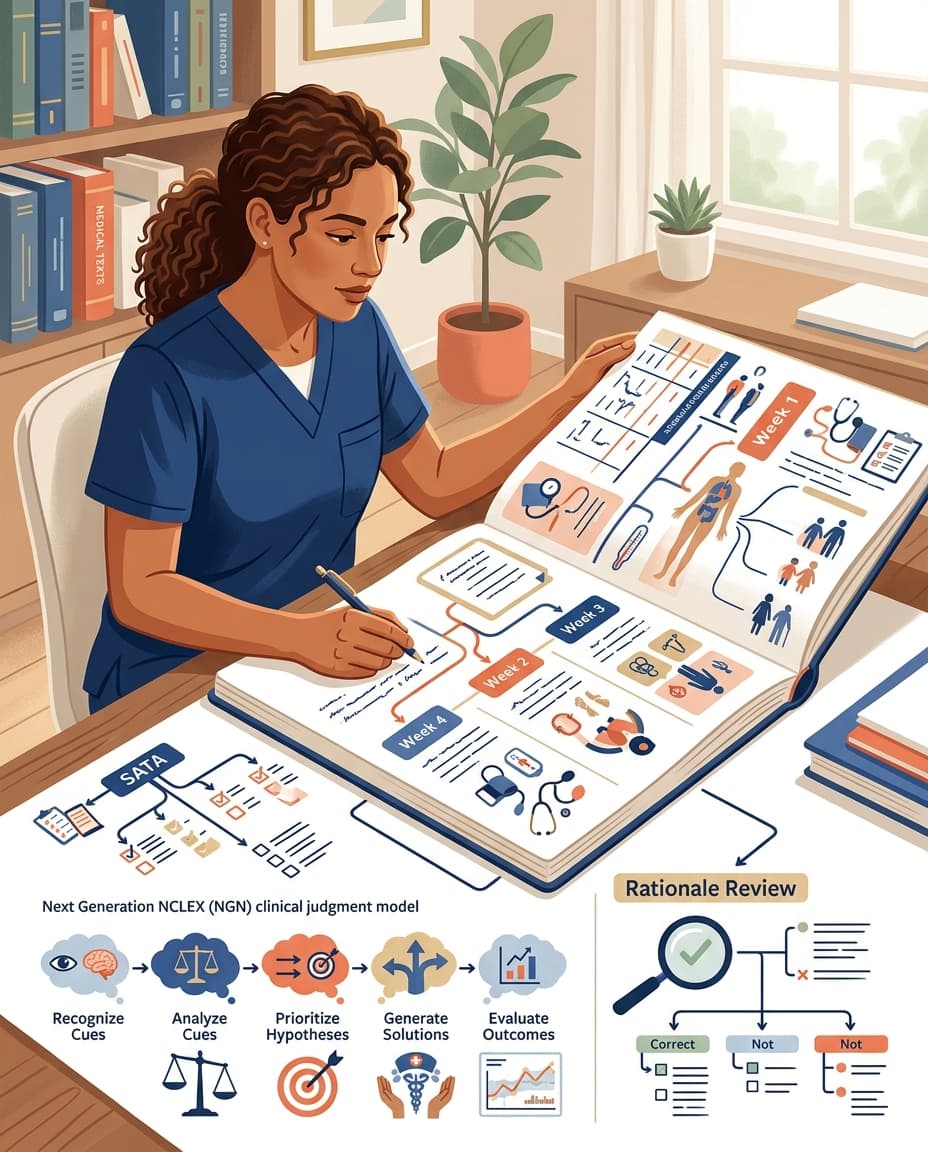
A structured 4-week NCLEX RN study plan organized around official NCSBN Client Needs category weightings, SATA question strategies, NGN clinical judgment techniques, and rationale review methods.
Nursing graduates often finish school feeling overwhelmed by the sheer volume of material covered on the NCLEX-RN. Re-reading comprehensive review books from cover to cover feels productive, but passive reading rarely builds the clinical judgment needed to pass a computerized adaptive test. Passing requires a structured approach that mirrors the actual exam design.
The National Council of State Boards of Nursing (NCSBN) builds the NCLEX-RN using specific category weightings. A realistic NCLEX-RN practice and prep schedule prioritizes high-yield domains like Management of Care and Pharmacology rather than treating every nursing topic as equal.
Why a Client-Needs-Weighted NCLEX Study Plan Is Essential
Moving from Passive Content Review to Active Clinical Judgment
Nursing school exams often test recall of facts or isolated diagnostic criteria. The NCLEX tests clinical decision-making under uncertainty. When faced with four plausible interventions, you must determine which patient to see first, which order to clarify, or which symptom signals immediate danger.
Leading NCLEX prep research shows that question-led practice with thorough rationale review improves clinical judgment and retention far more effectively than passive reading. Working through 40 to 60 targeted practice questions per day forces you to analyze clinical scenarios continuously.
Understanding the 2026 NCSBN Client Needs Framework & Category Weights
According to official NCSBN test plan data, content is divided across four major categories and eight subcategories. Spending equal time on each subject is inefficient because the test algorithm weights certain domains far more heavily:
- Management of Care (15% to 21%): Focuses on delegation, prioritization, advocacy, legal rights, and ethical practice.
- Pharmacological and Parenteral Therapies (13% to 19%): Covers dosage calculations, adverse effects, high-alert medications, and administration routes.
- Physiological Adaptation (11% to 17%): Covers acute medical-surgical conditions, hemodynamics, and emergency interventions.
- Reduction of Risk Potential (9% to 15%): Covers lab values, diagnostic tests, potential complications of procedures, and vital sign monitoring.
- Safety and Infection Control (10% to 16%): Focuses on standard precautions, surgical asepsis, error prevention, and emergency response plans.
- Basic Care and Comfort (6% to 12%): Covers hygiene, mobility, nutrition, sleep, and non-pharmacological comfort interventions.
- Psychosocial Integrity (6% to 12%): Covers mental health concepts, coping mechanisms, abuse, and therapeutic communication.
- Health Promotion and Maintenance (6% to 12%): Covers growth and development, prenatal care, disease prevention, and health screening.
Aligning your weekly schedule with these exact percentages prevents spending days on lower-weighted content while ignoring critical areas like care management or safety protocols.
The Week-by-Week NCLEX-RN Study Blueprint
This 4-week study plan structures daily review sessions around the NCSBN category distributions, incorporating daily question practice and structured rationale review.
Week 1: High-Weight Safety & Care Management (Management of Care 15% to 21%, Safety & Infection Control 10% to 16%)
The first week establishes core decision frameworks for priority setting, delegation, and safety protocols. These two domains combine for up to 37% of the total exam questions.
- Days 1 to 3: Prioritization and Delegation. Master frameworks like Maslow's Hierarchy, ABCs (Airway, Breathing, Circulation), and unstable versus stable client classification. Focus on appropriate task delegation to Licensed Practical Nurses (LPNs) and Unlicensed Assistive Personnel (UAPs).
- Days 4 to 5: Infection Control and Safety. Review transmission-based precautions (airborne, droplet, contact), personal protective equipment (PPE) donning and doffing sequences, and restraint protocols.
- Days 6 to 7: Review and Remediation. Complete a 50-question block focused strictly on Management of Care and Safety. Log every incorrect answer and rationale.
Week 2: Pharmacology & Basic Care (Pharmacological & Parenteral Therapies 13% to 19%, Basic Care & Comfort 6% to 12%)
Pharmacology represents one of the most challenging sections for test takers due to the large number of drug classes and side effects.
- Days 8 to 10: High-Alert Medications and Drug Classes. Group medications by suffixes and mechanisms rather than memorizing individual drugs. Prioritize anticoagulants, insulins, cardiac drugs, psychiatric medications, and emergency resuscitation drugs.
- Days 11 to 12: Basic Care, Comfort, and Parenteral Administration. Review intravenous lines, TPN (total parenteral nutrition) administration, pain management protocols, and mobility precautions.
- Days 13 to 14: Focused Question Drills. Practice calculating IV flow rates and dosage conversions. Run a 60-question block on pharmacology and basic care.
Week 3: Acute Physiological Adaptation & Risk Reduction (Physiological Adaptation 11% to 17%, Reduction of Risk Potential 9% to 15%)
This week covers medical-surgical concepts, diagnostic monitoring, and acute patient deterioration.
- Days 15 to 17: Complex Medical-Surgical Conditions. Focus on respiratory distress, cardiac dysrhythmias, stroke protocols, sepsis, and endocrine emergencies like DKA and HHS.
- Days 18 to 19: Diagnostic Monitoring and Potential Complications. Memorize crucial lab values (electrolytes, arterial blood gases, CBC, coagulation panels) and identify critical panic values that require immediate physician notification.
- Days 20 to 21: Mid-Point Assessment. Complete a timed 75-question mixed block across all categories studied so far. Analyze score reports by Client Needs categories to identify persistent knowledge gaps.
Week 4: Psychosocial Integrity, Health Promotion & Full NGN Simulations (Psychosocial 6% to 12%, Health Promotion 6% to 12%)
The final week covers mental health, life-stage health promotion, and full-length exam simulations.
- Days 22 to 23: Psychosocial and Therapeutic Communication. Study crisis intervention, therapeutic communication responses, substance use withdrawal signs, and mental health conditions like schizophrenia and major depression.
- Days 24 to 25: Health Promotion, Maternity, and Pediatrics. Review developmental milestones, immunization schedules, antepartum/postpartum warnings, and pediatric vital signs.
- Days 26 to 27: Full NGN Practice Exams. Take two comprehensive practice exams incorporating Next Generation NCLEX items under realistic testing conditions.
- Day 28: Final Light Review. Review high-yield lab values and core delegation rules. Avoid heavy testing or cramming the night before.
Mastering Select All That Apply (SATA) and NGN Question Types
Select All That Apply (SATA) and Next Generation NCLEX (NGN) clinical judgment items generate significant anxiety, but clear frameworks simplify answering them correctly.
The True/False Decision Method for SATA Questions
Avoid treating a SATA question as a single complex problem. Treat each option as an independent True/False statement evaluated against the stem.
- Isolate the stem: Read the clinical scenario carefully to identify the client, problem, and specific question asked.
- Evaluate option 1 independently: Ask, "Is this true for this client situation?" Mark it true or false without looking at the other choices.
- Repeat for each choice: Work through options 2 through 6 using the exact same rule. Do not compare choice 3 with choice 4.
- Accept partial credit scoring: The NGN uses +/- scoring for SATA items. Selecting correct options earns points, while choosing incorrect options subtracts points. If you are uncertain about a choice, selecting only those options you know are correct protects your score.
Navigating NGN Unfolding Case Studies and Clinical Judgment Steps
NGN case studies evaluate your ability to think through the six steps of the NCSBN Clinical Judgment Measurement Model (CJMM):
- Recognize Cues: Identify relevant subjective and objective assessment data from client charts, nurse notes, and lab values.
- Analyze Cues: Connect client cues to physiological or psychological processes to determine what is happening.
- Formulate Hypotheses: Determine the most likely underlying condition or priority problem.
- Generate Solutions: Identify desirable client outcomes and select appropriate nursing interventions.
- Take Action: Choose high-priority interventions based on urgency and client safety.
- Evaluate Outcomes: Assess client responses against expected outcomes to see if interventions worked.
When answering bow-tie or matrix items, focus on identifying the primary problem first before picking interventions or monitoring parameters.
Quality Over Volume: How to Remediate Practice Questions Effectively
Doing 100 questions a day without analyzing missed choices provides little benefit. Real progress comes from methodical remediation.
Building a Client-Needs Rationale Log
Create a remediation log organized strictly by the eight NCSBN Client Needs domains. For every question answered incorrectly or guessed on, record:
- The Client Needs Category: (e.g., Management of Care)
- The Core Concept: (e.g., Scope of practice for LPN)
- Why you selected the wrong choice: (e.g., Confused assessment duty with routine task)
- The takeaway rule: (e.g., LPNs can reinforce teaching, but initial assessment and initial patient education require an RN)
Analyzing your log weekly reveals patterns. If 60% of your incorrect answers fall under Pharmacological and Parenteral Therapies, shift additional practice time to drug mechanisms and dosage calculations.
Transforming Missed Rationales into Active Recall Flashcards
Static reading of rationales rarely builds long-term memory. Convert key rationales into clear flashcards for spaced repetition. Using an AI flashcard generator lets you turn written rationale summaries directly into interactive study decks without manual typing.
Review your flashcard deck daily in short, focused sessions to reinforce key facts like lab thresholds, drug antidotes, and isolation guidelines.
Automating NCLEX Practice with SyncStudy AI Tools
SyncStudy streamlines NCLEX preparation by converting your nursing notes, clinical summaries, and study guides into targeted practice materials inside persistent Study Spaces.
Generating Targeted Client-Needs Quizzes from Nursing Notes
Instead of relying solely on fixed question banks, you can convert your nursing lecture notes into customized question sets. SyncStudy's AI quiz generator processes lecture slides, pharmacology charts, and pathophysiology outlines to generate practice questions focused on specific Client Needs domains.
Upload your pharmacology notes or care plan summaries to create customized practice sets. The system generates scenario-driven questions that require analyzing cues and determining clinical priorities.
Simulating CAT Exam Conditions with Custom Study Spaces
SyncStudy allows you to organize study materials into dedicated spaces for each NCLEX domain. You can create a Management of Care space, a Pharmacology space, and an Acute Care space. Within each space, you can run timed practice quizzes, practice active recall, and query the Socratic AI agent to clarify difficult rationales.
To build custom exam simulations from your notes, consult our guide on how to simulate real exams from your study spaces.
Final Week Checklist & Exam Day Preparation
In the final three days before test day, adjust your focus from learning new content to physical readiness and mental clarity.
- 72 Hours Before: Complete your last full practice quiz block. Review your Client Needs rationale log for recurring safety rules.
- 48 Hours Before: Verify your testing center location, transportation route, and acceptable identification documents (unexpired driver's license or passport).
- 24 Hours Before: Stop heavy studying by noon. Prepare comfortable attire and pack snacks and water for testing breaks.
- Exam Day: Arrive at least 30 minutes early. Remember that the computer adaptive testing (CAT) algorithm adapts to your performance level. A higher difficulty level with challenging questions means you are performing well above the passing threshold. Take deep breaths, rely on your clinical judgment rules, and evaluate each SATA option independently.